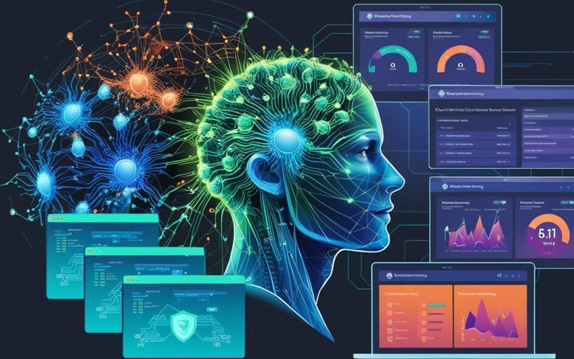
In the new digital era, where an enormous volume of data is constantly flowing, artificial intelligence plays a fundamental role in shaping the future of information security.
Organizations and companies are rapidly adopting AI‑based systems to both increase efficiency and strengthen their defensive capabilities against cyber threats.
This article provides a comprehensive examination of the impact of artificial intelligence on organizational information security, covering everything from valuable opportunities to potential challenges and risks.
You will see how artificial intelligence can transform the structure of information security, reveal vulnerabilities, and at the same time become a dangerous tool in the hands of cybercriminals.
It also explains how organizations can make the best use of this powerful technology through proper awareness and training.
Information Security in the Age of Artificial Intelligence
Recent advancements in artificial intelligence have compelled organizations to re‑evaluate traditional security models.
Technologies such as machine learning and behavioral analytics enable businesses to detect threats before they occur, yet these same technologies can become dangerous tools for sophisticated attacks if misused.
Organizations that understand the importance of information security know that proper use of AI can create a highly powerful defensive shield for data protection.
Meanwhile, the rapid growth of intelligent tools has introduced new challenges in data management, privacy protection, and intrusion prevention.
Smart security systems require extensive datasets for training, which can increase the level of data vulnerability.
This article examines how organizations can build a smarter and more secure structure for managing their information by understanding these challenges.
The Impact of Artificial Intelligence on Organizational Information Security: Opportunities and Challenges
While AI serves as a powerful protector in the realm of security, it can also become a tool for cyber attackers.
On one hand, intelligent systems can analyze vast volumes of data and detect abnormal patterns, helping organizations identify new threats faster than ever before.
On the other hand, cybercriminals use these same capabilities to conduct more precise and targeted attacks.
The main challenge lies in the ability of security systems to detect unknown attacks and novel techniques.
With the help of AI, attackers can create malware whose behavior constantly changes, making detection increasingly difficult.
Therefore, although AI represents a valuable opportunity for strengthening information security, without proper management, training, and strategy, it can also become a serious threat.
The Role of Machine Learning in Detecting Cyber Threats
Machine learning, one of the most important branches of AI, is heavily relied upon by organizations to enhance their information security.
Machine‑learning algorithms analyze millions of data points and identify abnormal behaviors, enabling early detection of attacks.
This is especially useful in identifying advanced attacks such as fileless attacks, self‑adapting malware, and insider threats.
Despite these advantages, machine learning also has limitations.
Algorithms may sometimes fail due to incomplete or inaccurate data, ignoring real threats or identifying normal activities as malicious.
To solve this issue, organizations must provide accurate and extensive datasets and avoid completely eliminating human supervision.
A combination of humans and AI yields the best results in threat detection.
AI‑Driven Threats and Next‑Generation Attacks
With the growth of intelligent technologies, cyber attackers have gained access to more sophisticated tools.
Today, we see attacks that are entirely designed and executed by AI systems.
These types of attacks often have the ability to morph and adapt themselves to the target’s security defenses, making detection significantly more difficult.
Intelligent phishing, voice and image spoofing, and self‑deciding malware are examples of this growing trend.
These threats become especially dangerous when attackers use organizational data to train their malicious models.
In such cases, attacks become not only more precise but also highly personalized.
Therefore, businesses must evolve their security strategies to address these threats and adopt AI‑based security technologies capable of detecting suspicious behaviors without relying on predefined patterns.
How Can Artificial Intelligence Strengthen Information Security?
The important point is that when used as a defensive technology, artificial intelligence can be extremely powerful for organizations.
AI dramatically increases data-processing capabilities and enables flawless 24/7 monitoring.
Intelligent systems are also more accurate than human forces in analyzing security events and can distinguish real alerts from false alarms.
Organizations that make proper use of these capabilities can detect and neutralize many cyberattacks before they occur.
Examples include intrusion detection systems, smart firewalls, and behavior‑based authentication systems.
These technologies help enhance information security and strengthen resilience against emerging threats.
Creation of Sophisticated Attacks Using Artificial Intelligence
One of the most challenging issues regarding the impact of AI on organizational information security is the possibility of attackers using the same technology to enhance their attacks.
Today, creating self‑learning malware or attacks that adapt based on the target’s defensive behavior is no longer difficult.
This has significantly increased the level of cyber threats compared to previous years, forcing organizations to adopt more advanced defensive technologies.
One of the biggest problems is that AI‑based attacks can quickly identify new vulnerabilities and change their attack method within fractions of a second.
Such flexibility renders traditional security systems practically ineffective.
Therefore, organizations must continually update their infrastructure, use intelligent analytical systems, and strengthen their security teams to counter these threats.
The Importance of Employee Awareness in Enhancing Information Security
Employee awareness is one of the most important elements of information security in the age of AI.
No matter how powerful intelligent systems are, they cannot guarantee full security without proper user behavior.
Many successful attacks result from human errors such as opening suspicious links, using weak passwords, or unintentionally sharing information.
Organizations must conduct regular training sessions to educate employees about emerging threats and ways to counter them.
This training should include identifying social-engineering attacks, protecting sensitive information, and the proper use of AI tools.
Employee awareness, combined with technology, creates a strong defensive layer that significantly reduces the risk of breaches.
Benefits of Using AI in Information Security Management
The use of intelligent tools in information security provides numerous benefits for organizations, but improper use of these tools can also create problems.
Some of the most important advantages include:
- Faster threat detection, more accurate event analysis, lower security costs, and enhanced continuous monitoring without the need for a large human workforce.
- These benefits allow organizations to manage their information security more efficiently and at lower cost.
- However, achieving these benefits requires proper infrastructure, employee training, and the implementation of a comprehensive security strategy.
Without these conditions, the use of AI may even increase vulnerabilities.
Recommended Strategies for the Safe Use of Artificial Intelligence
Organizations that intend to use AI to strengthen their information security must adopt a set of practical strategies.
First, smart systems must be regularly updated and equipped with the latest algorithms, reducing the likelihood of exploitation through security weaknesses.
Second, human supervision must not be removed—security experts should review AI analyses and make final decisions.
Furthermore, implementing clear security policies for employees and using advanced encryption tools is essential.
If organizations approach information security in a structured way from the beginning, they can enjoy the benefits of AI without worrying about potential threats.
This approach is especially critical for companies dealing with sensitive data.
Without a doubt, artificial intelligence will transform the future of information security.
With its unique capabilities, it can enhance organizations’ ability to combat cyber threats.
However, the same technology can become a serious threat if used without proper awareness, training, and a strong security framework.
Organizations must maintain a balanced and informed approach to AI and create a powerful security system by combining technology, employee training, and continuous monitoring.
Ultimately, the future of information security belongs to the organizations that can use AI intelligently and responsibly.
Source » Yuzit Academy