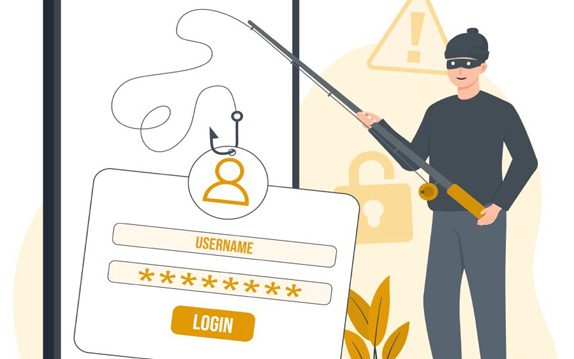
In today's complex world, the starting point of many cyberattacks is not a major breach, but a very simple human behavior: opening an email.
What users often perceive as a normal “new invoice” or “job applicant resume” message can turn into a launchpad for deep intrusion into the organization’s network.
This article, by illustrating a real scenario, shows how small behavioral mistakes can create a chain of events that eventually lead to an organizational disaster.
We then explore the importance of employee training, the critical role of behavioral analysis, and of course, the impact of the new generation of AI tools in reducing this threat.
Just as artificial intelligence has increased hackers’ speed, it can also help organizations detect risky behaviors and provide preventive alerts.
The main goal of this article is to create a clear understanding of how a simple click can be the starting point or endpoint of an organization’s security.
Hacking an Organization: From a Simple Email to Organizational Disaster
Many security scenarios begin with a simple email; an email that appears harmless but actually contains a malicious attachment or link.
Employees, due to work pressure, insufficient training, or even overconfidence in the internal email system, open these messages without careful inspection.
This is where the first link in the chain of danger forms, giving hackers the opportunity to begin scanning the system using the malicious file.
In such circumstances, an organization’s hacking is not the result of a complex action, but the consequence of a simple click.
After the malicious file is opened, the malware quickly begins establishing communication with the attackers' command-and-control servers.
This communication allows them to gradually gain control over parts of the system, collect data, or open new pathways for infiltration.
At this stage, even without the user noticing anything, the attacker has essentially entered the network.
This is exactly when the organization becomes vulnerable to deeper infiltration and the second stage of the attack begins.
The Role of User Behavior in Initiating a Crisis
User behavior is the most important factor in the success of attackers in many cyber incidents.
Organizational defense lines are usually effective only as long as humans don’t bypass them.
Many employees still don’t know how to recognize a suspicious email or why they shouldn’t click on any unknown attachment.
This behavioral gap creates a perfect entry point for attackers.
This gap cannot be filled only with technical tools; it requires a shift in organizational culture as well.
In this path, periodic training, attack simulations, and increasing sensitivity to digital threats can play an important role in reducing the risk.
However, threats evolve so rapidly that training alone is not enough.
User behavior must be continuously monitored to detect early signs of danger.
Only under such conditions can the third stage of an organizational breach be prevented.
The Entry of Artificial Intelligence into the Security Equation
Artificial intelligence today plays a dual role in the security world.
On one hand, hackers use it to craft convincing phishing emails, impersonate individuals, and automate attacks.
On the other hand, the same AI can analyze abnormal user behaviors and issue warnings before an incident occurs.
This capability transforms security from a reactive state to a proactive one.
As a result, organizations gain the ability to detect threats before they escalate into full-blown crises.
AI tools can record behavioral patterns of users and identify small but meaningful deviations.
For example, a sudden large download of data, logging in from unusual geographic locations, or attempts to access sensitive files—all can be early signs of intrusion.
At this stage, the last possibility of the organization being hacked can be completely neutralized before it occurs.
Signs and Stages of a Real Intrusion Scenario
A simple scenario that starts with an email typically includes several key stages.
These stages resemble puzzle pieces that together form the full image of the intrusion.
If even one of these stages is detected in time, the entire attack can be neutralized.
Here, once and in summary, we review the classic stages of such an attack:
Sending a phishing email, executing the malicious file, the malware connecting to the attacker’s server, initial information gathering, lateral movement within the network, data exfiltration.
Each of these stages is time-consuming but continuous, and the attacker attempts to proceed without creating the slightest trace.
Timely detection usually happens through user behavior analysis or log analysis.
If the organization lacks proper tools or employees ignore warning signs, the attack easily succeeds.
It is at these points that the importance of training, cultural awareness, and intelligent tools becomes more evident than ever.
Source » Yuzit Academy